What causes kidney stones and how to treat them
The tiny terrors that cause so much pain


 RSS Feed
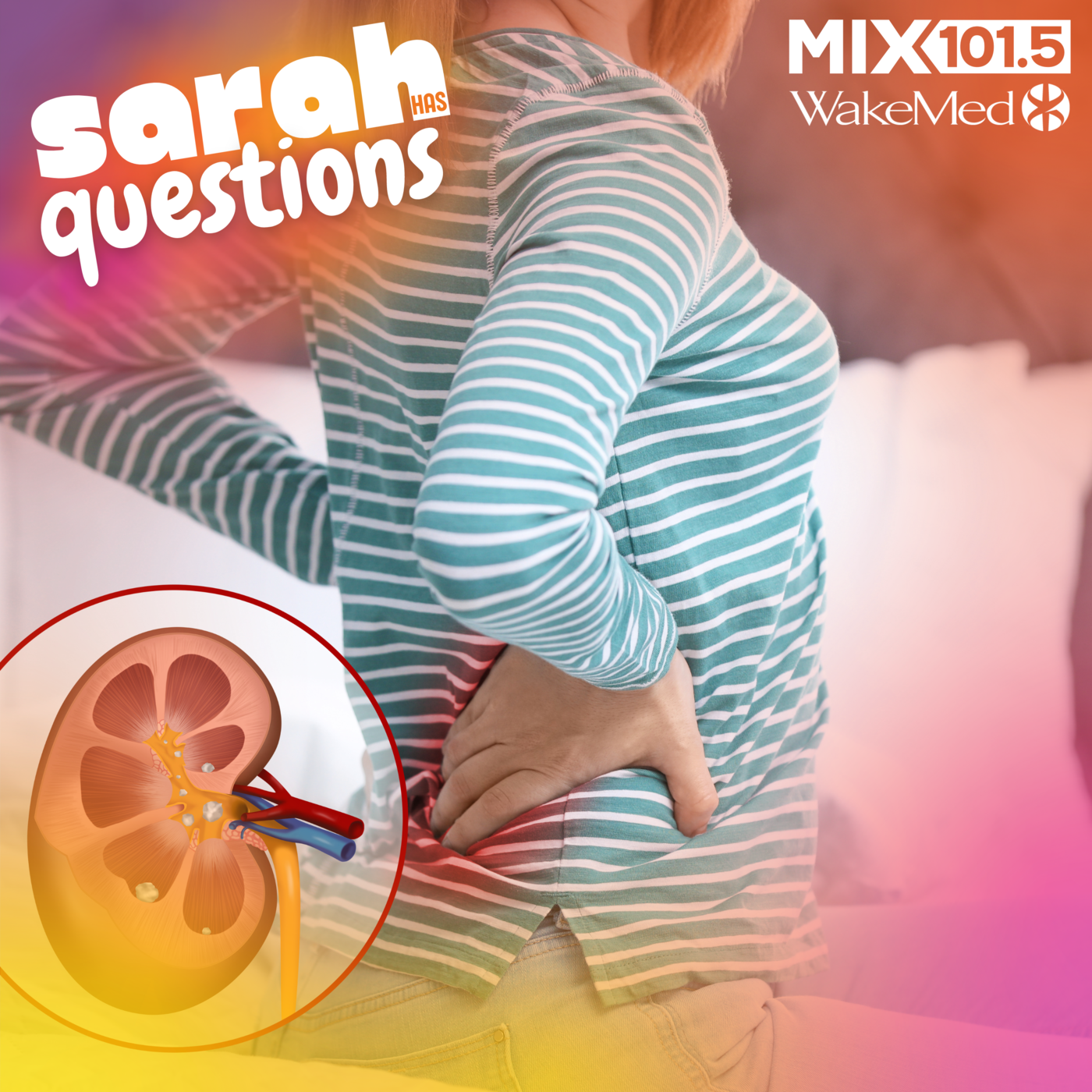
 An attack of kidney stones is enough to drop a strong, healthy person to the ground. Why is the pain so terrible? What causes stones to form? And most importantly, how can we prevent and treat recurrent stones? Dr. Josip Vikina has the answers! We're talking about foods that cause stones, the impact of too much tea, and treatments like lithotripsy, medication and stents.
If kidney stones are a recurrent issue for you, check out WakeMed's Kidney Stone Center for treatment. https://www.wakemed.org/wakemed-physician-practices/specialties/urology/kidney-stone-center
Send us your ideas for future episodes at www.wralfm/com/sarahhasquestions
DISCLAIMER: The information presented in this podcast is intended to be educational and nothing said by the host or guests should be taken as medical advice. The information presented here is not a substitute for professional medical advice, diagnosis, or treatment. Your health is important, and seeking the advice of your own healthcare provider is always the best course of action.
0:00 Have you ever had a kidney stone? They look really painful. My brother got one during thanksgiving once. Woof. Some people say the pain is worse than childbirth, and some poor people get them over and over and over again. There are treatments and I have a lot of questions about them. Let's get into it. I'm Sarah King and I have a lot of questions. What exactly happens when you orgasm physically? Will popping a knuckle or a joint give us arthritis? What can we learn from our poop? The size of your body doesn't necessarily indicate your measure of health. Yes. And what are your thoughts on that? Cleansing. Do we need to do anything special to our nether regions? In this show, I get to ask all these questions to WakeMed doctors who happen to know everything about everything. Sarah has questions is a production of Capital Broadcasting Company and Mix 101.5.
0:52 It's presented by WakeMed. Today, I'm speaking to doctor Josip Vukina. He is a urologist with, WakeMed. Welcome. Thanks for coming in. Thank you. Thanks for having me. And we're talking about kidney stones. I have a small story. My brother once abandoned cooking Thanksgiving because of a kidney stone. He just disappeared. All of a sudden, things started to burn, and then I found him later upstairs just writhing in pain. It's a common thing, apparently. Sounds about right. Yeah. Do men get them more than women? A little bit, but we see men and women. So it's statistically, it's a little bit higher in men. Oh, okay. That's pretty close. Well, let's start with the anatomy. Where do the the stones form and what causes that sudden pain?
1:34 So your kidneys filter your blood and all the waste products get made into urine. Mhmm. And so a kidney stone forms in the kidney. And they can sit there and not cause any trouble, or usually when we hear about them, they're on the move, so they come down the ureter tube and then into the bladder, and then they have to come out of the urethra. So people mix up ureter and urethra, but the ureter is that tube that connects the kidney and the bladder, and that's where the stones can get stuck. And that's usually where all the problems are. And so why does it hurt so bad? It's the it's not the stone that hurts. It's actually the backup of pressure behind the obstruction. So it's a backed up urine that fills the kidney, and the kidney is very sensitive to that. I see. And that's what hurts. So if you have a stone that's just sitting in the kidney, it doesn't actually cause you any pain. Interesting. And does does everybody have kidney stones? Not everybody, but a lot of people. And will they all will they eventually all move, or do they can they sit there forever?
2:28 Not necessarily. So we have some patients we just monitor, and their stones never move, and we don't have to do anything. The problem is you never know when it's going to move. So Yeah. Oh, interesting. And how do you find the kidney stones? On some sort of imaging. So most commonly, you go to the ER or you, you know, go to your primary care doctor, you get a you get a CT scan for some unrelated reason, and we can find stones in your kidney. Or if you're having symptoms, then we know what we're looking for. Oftentimes, we'll start with an X-ray, maybe ultrasound, but a a CAT scan or a CT scan is by far the most accurate. Okay. And what what are the symptoms exactly? I know that writhing and pain is one of them because I saw my brother do it. That is one of them, definitely. Blood in your urine. Okay. You can also feel the urgency and and frequency and the need to urinate. And it sounds like a UTI.
3:21 Be a UTI. So a lot of times, patients will have gotten I don't wanna say mistreated, but sort of thought that the other doctor thought they had a UTI. They treated that. It didn't get better. Right. And then we start looking some more, and, actually, they have a stone. Yeah. Because of the I've had a UTI and it ended up with blood. So they do look a lot alike. A lot of times you'll have blood and you won't potentially, you won't have any symptoms at all. So there's just blood in the urine because the stone's scratching around in the kidney. Okay. So that makes you think a lot about stones. Yeah. But the the most common, the sort of most memorable one for people is just that pain from the stone being obstructing. Yeah. And your back your back hurts, your side hurts. Oh. And as the stone progresses down farther, that's that pain can sort of move around to the front. And so some people have lower abdominal pain or groin pain, things like that. And they say it's worse than childbirth, which I can't vouch for that myself. Women say it. But I have heard that from multiple women that they'd rather have another baby than have a kidney stone. So that seems I don't believe it. Seems bad.
4:20 So with blood, speaking of women, is it more difficult let's say the person's on their period. Is that gonna affect finding things out? It can. We can if we're if we're confused by that, if that's really if the decision is hinging on that, you can do a little catheter sample or you only get urine that's just inside the bladder. Yeah. So you can't get any other contamination in it. So you can Yeah. You can sort of figure it out that way. Okay. And does diet and hydration affect this? Hydration is big time. So that's our biggest prevention tool is hydration. So I just tell patients if you imagine dissolving a spoonful of sugar or salt into a glass of water, right, the more volume that's there, the more water that's available, those crystals will dissolve.
5:04 Oh, that is a good analogy. You have some amount of stone crystal there and you hydrate well, it won't precipitate or come out of solution and form a kidney stone. Or rock candy, which would be the answer. That's exactly. That's something that I don't know. Stone is essentially rock candy. Yeah. So it's sugar so that's sugar those are sugar crystals. The same thing's happening with with stone crystals. And so what what is in the crystals that are forming in your bladder? The most common Or kidneys, that is. Storm the the most common stone is, is a kid is a calcium based kidney stone. Where does that come from? Like, when what what am I eating that's causing a calcium, or do we even know that? Well, we have a lot of calcium just in our body, in our bones, in our that we digest and absorb from our gut.
5:48 Mhmm. It's floating around in our bloodstream. Mhmm. So if you have maybe a genetic predisposition or if you have a high calcium diet or you're on some particular medications, you may get more calcium in your urine than is normal. Okay. And then you've sort of tipped that you've tipped that rock candy balance I see. To where these crystals come out. And then once there's a spot there for the other crystals to to hang on to, then that's how those stones will go. It just aggregates. Yeah. Can you see them whenever they come out? You can. They're usually small. You're usually unimpressed when you see them. Because they feel so painful. Was there. But Yeah. But you can. Usually, you can see them. That is the upside of having a kid.
6:29 You know you you know what I You get a kid from the pain. Yeah. You do. So you mentioned medications. What kind of medications can cause, kidney stones to form? It gets a little technical. There's some, there's some diuretic medications that people are on for blood pressure. Okay. So they cause you to, you know, sort of ironically enough, cause you to make more urine. But the way they do that is you release more calcium into your urine. Oh, okay. There's also some migraine medications. That stuff's probably not in the average person, not a huge problem Right. That we think about. But if you have a recurrent stone patient who's constantly in the office, that's an important thing to sort of comb through their medication list and make sure. Yeah. What about supplements? Because I know people some people we have a woman here who has a GNC store in her desk. She has so many supplements. So are there certain supplements that do it? I generally don't dissuade people from calcium, particularly, you know, kind of around menopause for women, things like that. But if if you are a frequent stone former, you should at least talk to your doctor about which supplements you're on and how to take those and when take them with food or not, the time of day, that kind of stuff. Does alcohol cause cause more stones? Generally not. Wow. Yeah. So first time alcohol didn't do it. Yeah. That's right. And everything else we talk about. Lots of other stuff to worry about. Yeah. But not kidney stones. Not. Okay.
7:53 Good to know. So you're saying that some people form stone stones more than others. Do you find that genetics plays a role in this? So if your mom did it or your dad had stones, you might have them as well? Definitely. Oh. And a lot of times, we if we see young patients, you know, 20, 3rd, or old with stones, almost always their parents had stones. Mhmm. So there's a strong genetic predisposition. Do you find more ethnic groups have them? It's probably out there in the literature somewhere. Not that I not that I'm aware of. Okay. Yeah. Not not that I know of. And you already said that women don't seem to get them more than men or men more than women? Men a little bit more than women. We'll be right back because you know I have more questions.
8:39 As far as treatments go, what kind of treatments do we do for these? So, there are are national organizations called the American Urologic Association. So they write lots of guidelines for all the different things we do. It's a little technical, but there's actually some nice information on there. And so they, they have a couple of these scenarios that they will recommend, certain treatments based on. So, if a stone is under a centimeter Uh-huh. Which is what about half an inch, if your pain is reasonably controlled, sort of the first guideline recommendation is you try to let the patient pass that. That's a big stone. You know, in my practice, I probably say about half that.
9:20 So, like, a 5 millimeter stone Yeah. Has a pretty decent chance of passing. And if if we've, you know, seen you by the time the stone's in the bottom of the ureter and it only has a little ways to go, then it's probably waited out. Yeah. So, you know, pain medication, there's a muscle relaxant that's specific to the urinary tract that will sometimes help pass stones. So we try to give those patients 2 or 3 weeks, and then they come back with another imaging test. 3 weeks? Which can be a lot. So if you're not if you're really uncomfortable, then we look at the different treatment options. And so those are generally based on the size of the stone Yeah. In the location. Okay. So, the most common is an endoscopic approach. So there's no cuts on the skin. So we go in the bladder and we go up the ureter tube with a little teeny camera, and we can pass instruments in and out of that camera. So you can take a laser and break the stone into some smaller fragments. Okay. Then we have these little baskets that you can use to pull all the fragments out. Be really little. They're very small. Yeah. So it's, it's delicate work. Yeah.
10:20 Sometimes we just blast the stones into small enough pieces that everything will pass on its own. Yeah. I heard that And I just have to And I don't know if this sounds true, but I heard that you can use sonar, sonic booms. So, yeah. So there's another technique, called external shockwave lithotripsy. So lithotripsy means stone breaking. So you use an external sound wave. So you're under some sedation. You're lying down on the bed, and we we home in a really, tight sound wave, and we blast the stone into small fragments. Can you hear it? It makes sort of like a popping sound. Oh, interesting. Yeah. Okay. Cool. So it's like a mini sonic boom. Yeah. And so, the those work really well if the if it's if those patients are selected properly. So a certain, hardness to the stone beyond that point, it's hard to break. The stone's just too dense. It's hard to break it. Yeah. It has to be the right size. It has to be in the right location. Can you break them up in the if you have a bunch of stones hanging out in your kidneys, can you break them up in the kidneys?
11:19 Or does it have to be in the ureter? No. You can. Usually, that shock wave treatment, you only get a fixed number of shocks in a session because there is a little bit of scatter of that energy. So you can Hurt yourself. Have some bleeding and cause some other issues. So we generally try to focus on just one stone so that you can use all those shocks on that one stone. Okay. Cool. If you have a lot of stones in the kidney, you're better off with that endoscopic approach. Got it. Or if you have a stone in the ureter, which is causing a bunch of trouble, and then very often we're in there anyway, you have a stone in your kidney, we'll go in and clean that up as well so that we're not back here in 6 months doing the same thing. Yeah. It kinda reminds me of when they go in and put stents in the heart. Yeah. Do you do do you ever do that where you just kinda stretch it out? Very similar. Exactly.
12:04 Yeah. So, there are stents for the ureter. Oh, okay. So when you're done typically, when you're done, if you just picked up everything and left, the ureter is very inflamed and angry from all the instruments that have been in and out of there. So it'll squeeze shut, and then the kidney can't drain. Yikes. So when we're done, even if everything is perfect and all the stones are gone, we leave a stent in for, usually, a couple days to a week. Do you have to get it taken out? No. You get it taken out. Sometimes we leave it on a string, and you can take it out at home. Oh. Or if you or the alternative is you come back to the office for a little office procedure, and we just put a camera in and take it out. The string was unexpected. Yeah. So can kidney stones be prevented? Definitely. So that's a big part of our practice. So WakeMed has this kidney stone center. You can call us. We usually try to get folks in within a day or 2 if they're having an acute stone episode. And then the other, I think, huge benefit of that of this of our whole practice is we have a kidney stone prevention clinic. So we have, a nephrologist who's a medical kidney specialist, not a surgeon, but sort of more on the medical side. They work closely with a nutritionist, dietitian type person. Mhmm. And so a lot of our younger stone patients or frequent flyers who have a lot of stones You don't wanna be in that part. Wanna be yeah. You don't want that part. Then when we're done acutely treating their that episode, we always send those stones for a chemical analysis. Okay. And then we do a big battery of tests to help with prevention. And so, there's a lot of blood work to do and then a 24 hour urine collection, which is sort of a
13:37 nuisance, but you get a ton of information about all the chemical makeup, all the levels of different chemicals in the urine. Yeah. What could be causing the stones? So then there's some patients where everyone should work on hydration. Almost, I mean, almost everybody has lower lower than we want urine volumes. But then there's a lot of other you know, if you have high levels of calcium, there may be a medication to use. Yeah. There are certain stones that only form in certain acidity environments. So we can change the acidity level of your urine with the medication, and then that actually will cause it to dissolve back into its Wow. Dissolved form. So it's not a stone anymore. Yeah. So there's a lot of prevention to do. You mentioned volume of urine. What what volume would you like to see people getting? Yeah. So if you look at that, big guideline statement, it's, they mentioned the number of 2 and a half liters of urine. So you're drinking a lot of liquid per day. You're one of those water bottle people if you're gonna achieve that volume. So that's, you know, a gallon's 3.75 liters. So we're almost Almost a gallon a day. Half a gallon. And does it have to be water? Can I drink coffee? Can I drink, you know, tea? Yeah. So tea is a big problem because it's high in oxalate, which calcium and oxalate bind together to make stones.
14:55 So Oh. Down south, we call it the stone belt. Yeah. I bet. The sweet tea. We have a lot of dehydration, and we have a lot of of tea intake. So tea is not great. Water is is the best. And then we tell patients, lemon or lime into water gets used to citrate in your diet. Okay. Citrate actually prevents those crystals from binding together. What's what's a shame about that is you talk to a dentist. They don't want you to put them in. Yeah. That's right. There's no winning. Yeah. Pick pick your poison a little. Yeah. Exactly. But if you're prone to stones, which is a unfortunate poem, that is a way for you to, like, you know, help out. Lemon water, lime water. That's interesting. I didn't realize the tea thing because I'd heard brown liquids, which made made me you mentioned that alcohol didn't do anything, but whiskey, you know, is brown. So it's not just brown liquids. It's the tea that they're Tea is the tea is the biggest thing. Coffee is a little hard really to interpret. Depending on your overall hydration status, coffee can dehydrate you. Okay. But it's also a diuretic, so you make more urine. So, theoretically, you could be increasing your urine volumes. Right. Right. But only in short periods of time, and then you may actually end up dehydrating yourself. So coffee is a little hard to interpret. I tend to not Not care so much about coffee. Much of a stink with coffee, but if people are big tea drinkers Yeah. But, really, if if you can just get your volumes up with with water, you'll do yourself a lot of good. It makes sense for my brother because he drank Arizona iced tea, the Arnold Palmers Yeah. Like crazy. Yeah. So now I know why he
16:26 had those stones. I wonder if he knows that. I'm a tell him. You can tell him. Alright. We're gonna move on now to listener questions. Great. So, here let me ask the first one, which is how many times a day are we supposed to pee? That is a good question. I would say, on average, probably if you're peeing 5 or 6 times a day, you're well hydrated. Okay. I have some patients that when you quiz them on this stuff, they're like, oh, I pee twice a day, and that's definitely not enough. Yeah. Also, if you're getting up a bunch of times at night, that's pretty probably there may be some other things going on too. But Once a night's okay? On average Yeah. As we get a little older, that's a very common Okay. Number. Yeah. Because I know some people get up a lot, but some people say they have small bladders. Is that even a thing or is that more along the other things that play there? It can be. Your your bladder should hold about 500 cc's or ml's or so. So it's probably a soda can and a half. Okay.
17:22 If you as you get older, that capacity can go down or really the your brain gets signals at a lower volume really than it should. And so you think you have to go pee. So we can sometimes fiddle around with that a little bit with medications or or pelvic floor training, things like that. Okay. Does drinking cranberry juice help? And if it and if so, do I need to drink it every day? Or just when I feel like I have a stone, and why does it help? So there's a lot of questions in there. Yes. So cranberry is really more on the UTI side of things. I see. There is a substance in in really low doses in cranberry that will prevent certain bacteria from binding to the wall of your bladder. Oh, interesting. And so it's very hard to drink enough of that to get enough of that substance. They make pills. It makes yeah. So they make extract.
18:13 Cranberry extract will get you a lot higher concentration of that substance, and that's really more for UTI prevention. Got it. Doesn't really help so much with stones. Maybe a little bit of citrate and cranberry juice, but I think all the sugar that you'd be getting probably negates any potential benefits. So I wouldn't use that as a certainly, when you're having an active stone episode, it's not It's not gonna help. But a UTI, it might help Maybe. If you drink, like, 3 gallons in a day, which sounds horrible. My urologist ran tests on my stones and gave me a list of foods that contributed to them. It was basically everything I eat, even healthy vegetables. I can't cut out all these items. Is there, like, a top five list of things to avoid? We have this conversation all the time. So we have these sheets of foods to avoid that you give we give our patients, and it it's right. There's a lot of healthy nuts or high in oxalate, leafy green vegetables. I mean, there's lots of good things that we want you to be eating for other reasons. I tend to focus on the hydration. Okay.
19:12 So you can undo a lot of your risk factors with hydration. Okay. Avoiding a lot of salt intake. So, salt, the way that we excrete or get rid of extra salt or sodium is we release it in the urine, and then there's a little transporter mechanism that takes calcium with it. So the more salt you eat, the more calcium ends up in your urine. And the more stones. Rock crystal analogy. Right? So the the more calcium that's in the urine, the more stone formation you get. Okay. So canned food, processed food, eating out, those are that's how you get too much sodium in your diet. It's really rare when you cook at home that you're gonna eat anywhere near the amount of salt. I'm so glad you brought that up because some people won't salt their food at home. I'm like, dude, you're not salting it nearly as much as they do in a restaurant. That's why the food tastes so good. Yeah. That's right. And butter also. There's butter in all of it. Correct. So hydration, salt intake, anything else? Maybe not so much avoidance, but just the citrate idea. Right? So getting citrate in your diet to prevent stones. And then we do have oxalate.
20:17 Dietary oxalate does make some difference. So that's where some of those restrictions can be a little onerous. So, tea, if you can knock out tea, that's a really good one. If you're eating a lot of nuts, you know, for protein and things like that. What about red wine? Because is it what causes a tannin? Because tea and nuts both have that, like, drying of the mouth thing going on. Yeah. So is is it the same thing as a tannin? It's not. So, ox, I don't I don't know of red wine having a very high oxalate concentration. Again, I think unless you drink a lot Yeah. I think you're probably okay. Okay. So those are sort of the main things. Okay. And then a little bit it can get a little bit more personalized Okay. Depending on what your stone analysis shows. So so there's some stones made out of uric acid. Those are more related to meat protein. So if you're making those patients, a lot of patients have gout and have uric acid. Related to urine?
21:13 Yeah. So, similar idea, when you have gout, those are uric acid crystals that are building up in the joints and other parts of the body, so you can get that same process happening with a uric acid stone. Interesting. Okay. This one was brown drinks. We already covered that one. I feel like I get more kidney stones when I'm stressed. Is stress a factor? And have you seen other patients with this? I don't think so. Not that not that I've ever seen. Interesting. The the pure sort of science doesn't change based on stress levels that we're really aware of. It's it's really, you know, volume of urine with concentrations of those different chemical components of kidney stones. But, you know, we all know when we're stressed, we don't eat as well. We're probably not sleeping as much. We're not drinking the amounts of volume that we need to. So inadvertently, your gut. Ties into it. Yeah. That makes sense. It's I think if you're just having a really stressed out day, I don't think you're any more likely to pass a kidney stone. Got it. Alright. And last question. I have a family history of kidney stones. I've had several attacks and all kinds of treatments including lithotripsy. What can I do to help my kids avoid the same fate? We get this question a fair amount because this of the Stone Center. I think though these are probably families that would really benefit from, a stone prevention visit. So there's 24 hour urine tests, maybe some sort of baseline imaging just to see what's there so you don't it doesn't surprise you on vacation or whatever. Oh, yeah. That's totally terrible. Yeah. Yeah.
22:46 So those are folks we'd probably be a little bit more proactive in. But all the same all the same things we talk about would apply. So all those prevention strategies and dietary things and all that. So if someone doesn't have a history of stones and, I don't know, doesn't is it it isn't a top worry. Should they be going to your your prevention clinic or not really? It's not the easy way to go. Yeah. I think if you've had if you have a really strong family history, or if you've had a bunch of recurrent stones yourself. But I think in the average person, I probably wouldn't. Okay. Well, cool. Well, this has been really informative. I learned a lot. Thank you so much. Thanks for having me. Of course. So class, what did we learn today? Hydrate, hydrate, hydrate. Also, there are a lot of treatments available if you are prone to stones. Anyway, doctor Josip Fekina was my guest today. And if you're interested in WakeMed's kidney stone center, there's a link in the episode description. We had a lot of great listener questions about kidney stones. Thank you so much for sending those in. If you have a question or a topic for episode, let us know at wralfm.com/sarahhasquestions.
23:57 See you next time.


